
Copy Trading Platform Development: A Complete Guide for Brokerages & Fintech Startups
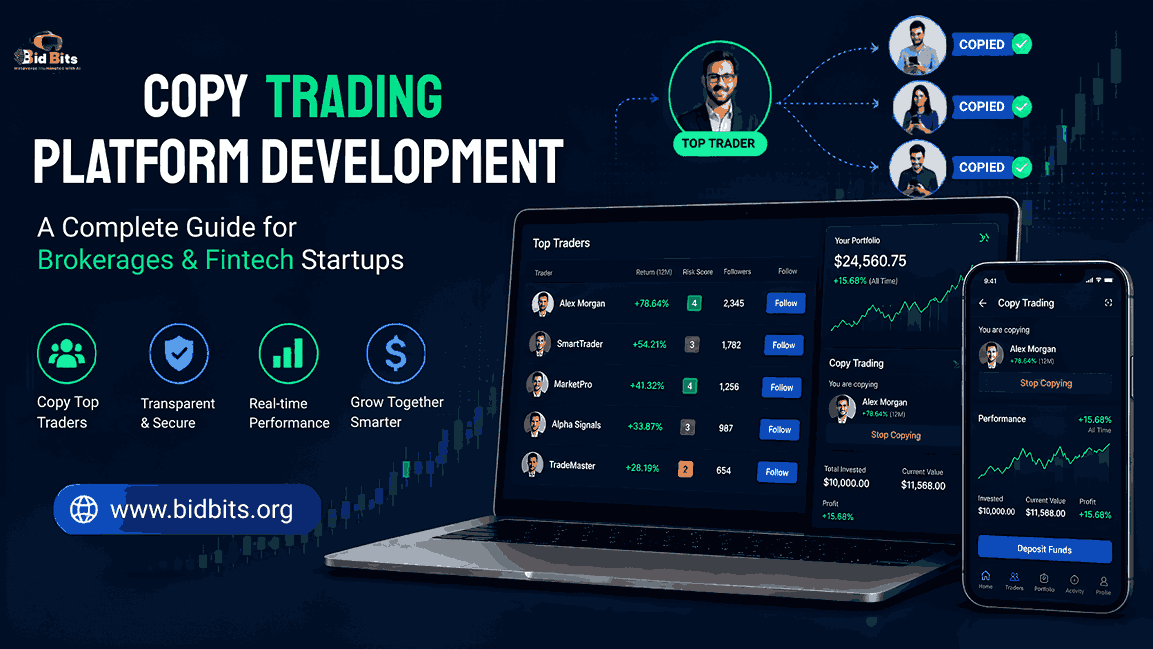
Copy trading has become one of the fastest-growing functions in retail brokers, currency exchanges, and crypto exchanges – it drives engagement, increases assets under management, and inspires less skilled clients vigorous life on the platform whether you’re brokering, changing the platform, developing or developing a found what you need to realize before writing a line of code or hint with the vendor.
What Is Copy Trading Software Development?
Copy trading software development is the process of building a system that lets one user’s trades automatically replicate into another user’s account in real time, proportional to account size and risk settings. It’s a deceptively complex engineering problem — it’s not just “copy the trade,” it’s a live system that has to handle:
- Real-time trade signal broadcasting with near-zero latency
- Proportional position sizing across accounts of different sizes
- Risk controls (stop-loss limits, max drawdown, auto-unfollow triggers)
- Broker/exchange API integration for order execution
- Trader ranking, verified performance history, and leaderboard logic
- Compliance and regulatory reporting requirements
Because of this complexity, most brokerages either build on top of an existing trading engine or bring in a specialized development partner rather than building the entire stack from scratch in-house.
Must-Have Copy Trading Features
If you’re looking for a custom build or a white label solution, here are the must-have features of your platform:
- Search trader profiles and discover traders based on verified win rate, drawdown, risk score and trade history.
- Proportional auto-copy engine — the basic feature that scales trade size to each follower’s account (not a fixed size).
- User-configurable Risk Management Controls Stop-Loss, Max Daily Loss and Max Allocation Per Trader.
- Real-time execution, low latency infrastructure — even a few seconds of latency can cause slippage and loss of trust in the platform.
- Multi-asset support, that is, forex, crypto, stocks, or commodities, as per the target market.
- Monetization options for traders — sharing profits, subscription fees or a split of the profits (where the best traders are rewarded for their continued participation on your platform).
- Compliance and KYC/AML integration, particularly important for platforms that serve customers in various jurisdictions.
- Admin dashboard and analytics — to show the internal team platform health, flag abnormal trading and maintain disputes.
- Mobile app parity — the most important thing to note is that the most copy trading users are looking for a true mobile experience, rather than a desktop experience.
Skipping any of these at the MVP stage is fine — but they should all be on your roadmap, because retrofitting risk controls or compliance tooling after launch is far more expensive than designing for them up front.
Build vs. White Label Copy Trading Platform: Which Should You Choose?
This is usually the first fork in the road for any team starting copy trading platform development.
Custom build (from scratch):
- Full control over features, branding, and architecture
- Easier to integrate with your existing broker infrastructure or liquidity providers
- Higher upfront cost and longer time to market (typically 4–9 months for an MVP)
- Best for brokerages with existing trading infrastructure and a differentiated product vision
White label copy trading platform:
- Pre-built core engine (trade copying, risk controls, trader ranking) that you customize and rebrand
- Significantly faster time to market (often 6–10 weeks)
- Lower upfront cost, though ongoing licensing fees apply
- Best for startups that want to validate demand quickly or brokerages adding copy trading as a secondary feature
Neither option is universally “better” — it depends on your timeline, budget, and how core copy trading is to your long-term product strategy. If copy trading is your entire business model, a custom build gives you more room to differentiate. If it’s a feature you’re adding to an existing brokerage, white label is usually the more capital-efficient path.
Crypto Copy Trading Platform vs. Forex Copy Trading Platform: Key Differences
The underlying copy mechanic is similar, but the technical requirements differ meaningfully depending on the asset class:
Crypto copy trading platform:
- Needs integration with crypto exchange APIs (or your own matching engine)
- 24/7 market operation — no downtime windows for maintenance
- Wallet security and custody considerations add engineering overhead
- Regulatory treatment varies significantly by jurisdiction and is still evolving
Forex copy trading platform:
- Typically integrates with MetaTrader (MT4/MT5) or cTrader via bridge APIs
- Established regulatory frameworks in most major markets
- Leverage and margin call logic need to mirror your broker’s existing risk engine
- Trading hours align with global FX market sessions, simplifying uptime requirements
If you’re planning to support both asset classes on one platform, budget extra development time for a unified risk engine that can handle the different margin, leverage, and settlement rules of each.
Copy Trading Software Cost: What to Budget For
Cost varies widely based on scope, but here’s a realistic range for 2026:
| Approach | Typical Cost Range | Timeline |
|---|---|---|
| White label platform (rebrand + light customization) | $15,000 – $50,000 | 6–10 weeks |
| Custom MVP (core copy engine + essential features) | $60,000 – $150,000 | 4–6 months |
| Full custom platform (multi-asset, compliance, mobile apps) | $150,000 – $400,000+ | 7–12 months |
Costs are driven primarily by:
- Number of asset classes and broker/exchange integrations
- Whether you need custom mobile apps (iOS + Android) or a responsive web app only
- Compliance requirements in your target markets
- Whether you’re integrating with an existing trading engine or building the matching/execution logic from scratch
Get itemized quotes from any development partner rather than accepting a single lump-sum number — it’s the only way to compare where your money is actually going.
Choosing a Copy Trading Platform Development Company
Not every software vendor that says they can build “trading apps” has the specialized experience copy trading requires. When evaluating a copy trading platform development company, ask about:
- Previous copy trading or social trading platform experience — request to view case studies or working platforms they’ve created, and not generic fintech portfolios!
- Experience with broker/exchange API integrations — relevant to your asset class (MT4/MT5, cTrader, specific crypto exchange APIs).
- In-house compliance and security expertise — copy trading platforms handle real money and real regulatory exposure; this isn’t optional.
- Post-launch support model — copy trading platforms need ongoing monitoring, latency optimization, and feature iteration; make sure support doesn’t end at launch.
- Whether they offer white label and custom builds — a vendor that only pushes one option may be fitting your project to their product, not the other way around.
A short technical discovery call is often enough to determine whether a development team understands key trading requirements like position sizing, execution speed, and risk management, or is simply approaching it as a standard software project.
Final Thoughts
Copy trading platform development sits at the intersection of real-time systems engineering, financial risk management, and regulatory compliance — it’s a meaningfully harder build than most fintech features, but it’s also one of the highest-engagement features you can add to a brokerage or exchange. Whether you go white label or custom, the decisions that matter most early on are your asset class scope, your risk engine design, and the development partner you choose to execute it with.
Thinking about building a copy trading platform for your brokerage or exchange? [Get in touch with our team] for a free technical scoping call — we’ll walk through your requirements and give you a realistic cost and timeline estimate before you commit to anything.